
Class 8 Cleanroom Monitoring: Why Compliance Is Not Enough to Control Particle Contamination
Why Is Handheld Particle Monitoring Important in an ISO Class 8 Cleanroom?
Meeting ISO Class 8 cleanliness requirements is essential, but effective contamination control also requires an understanding of how airborne particle concentrations vary across a cleanroom. Particle levels can change with personnel movement, equipment operation, material transfer and airflow disturbances.
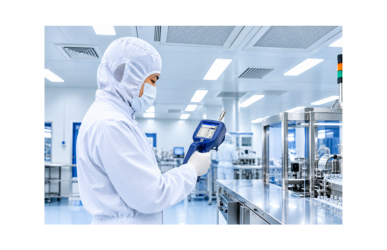
A handheld particle counter enables personnel to take measurements at specific locations, investigate unexpected changes and compare results across the cleanroom. This makes it a valuable tool for routine monitoring, troubleshooting and environmental assessments.
1. Spot Monitoring at Multiple Locations
Particle concentrations may vary between different areas of a cleanroom. Doors, material-transfer points, production equipment and operator workstations can experience different particle levels depending on room activities and airflow conditions.
A handheld particle counter allows operators and quality teams to take measurements directly at predefined sampling points and investigate areas of concern.
Why it matters: Monitoring multiple locations helps identify localised particle variations that may not be apparent from measurements taken at a single point.
2. Faster Investigation of Unexpected Particle Increases
An unexpected increase in particle counts may be associated with personnel movement, door opening, material handling, cleaning activities, equipment operation or potential HVAC-related issues.
With a handheld particle counter, personnel can measure the affected location and nearby areas to gather additional information for the investigation.
Why it matters: Targeted measurements help teams narrow down potential contamination sources and determine whether further investigation of airflow, filtration or operating practices is necessary.
3. Support for Routine GMP Environmental Monitoring
In pharmaceutical and other regulated manufacturing environments, particle monitoring should follow an approved environmental monitoring programme. Handheld particle counters can support periodic measurements at predefined locations under specified operating conditions.
Results should be documented and reviewed against established acceptance criteria, with unexpected readings investigated according to site procedures.
Why it matters: Consistent monitoring supports traceable records, trend analysis and evidence-based investigations of particle-count excursions.
4. Verification Following Cleaning and Maintenance
Cleaning, HVAC maintenance, filter replacement and equipment servicing can influence airborne particle levels. Following these activities, particle measurements can help assess whether the cleanroom has returned to its required environmental conditions.
Measurements should be performed at appropriate locations and under the conditions defined by the facility's approved verification procedure.
Why it matters: Post-intervention monitoring helps identify potential issues before routine operations resume. Room release must follow the applicable acceptance criteria and approval process.
5. Support for Cleanroom Qualification and Commissioning
During cleanroom commissioning, qualification, requalification or investigations involving HVAC performance, particle measurements may be taken at multiple sampling locations to assess airborne cleanliness.
A portable particle counter provides flexibility when comparing locations and investigating areas that require additional attention.
Why it matters: Location-specific measurements contribute to the overall assessment of cleanroom performance when used alongside the required airflow studies, differential pressure measurements and filter-integrity tests.
6. Identifying Localised Particle Hotspots
An ISO Class 8 cleanroom classification does not mean that particle concentrations are identical throughout the room. Localised increases may occur near personnel, equipment, doors or material-transfer areas, depending on the operating conditions and airflow patterns.
A handheld particle counter allows personnel to investigate these locations and compare readings with measurements from other sampling points.
Why it matters: Identifying localised particle variations helps quality and engineering teams focus their investigations on areas that may require corrective action rather than relying only on overall classification results.
TSI AeroTrak™ Handheld Particle Counter 9306-V2 for Cleanroom Monitoring
The TSI AeroTrak™ Handheld Particle Counter 9306-V2 is designed for portable airborne particle measurements and can support cleanroom monitoring, contamination investigations and indoor air quality assessments.
Its handheld design allows personnel to move between designated sampling locations, making it suitable for investigating particle variations and collecting measurements as part of an established monitoring programme.
For facilities looking to strengthen their particle monitoring practices, the instrument can complement fixed monitoring systems and other environmental measurement equipment.
Explore the TSI AeroTrak 9306 product page.
Important: A handheld particle counter measures airborne particle concentration. It does not independently verify airflow patterns, differential pressure or HEPA filter integrity. These parameters require appropriate instruments and test methods.