
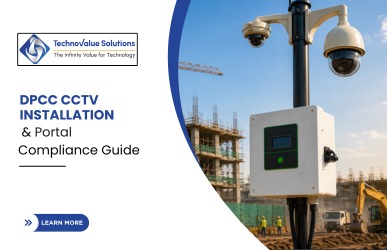
DPCC CCTV Installation & Portal Compliance Guide
Delhi's Air Quality Crisis
Millions of residents in India's capital, Delhi, breathe polluted air comparable to smoking nearly nine cigarettes every day. What has become a daily reality is also a growing public health emergency. Research indicates that air pollution contributes to roughly one out of every seven deaths in the city, claiming over 17,000 lives annually. Behind these numbers are emissions from stubble burning, vehicular emissions, waste handling, and construction and demolition, contributing up to 15-30%.
As Delhi pollution has got worse, relying only on periodic inspections is no longer enough. Regulatory authorities and industries alike need continuous, verifiable evidence that pollution control measures are not just documented but actively implemented, making technology-driven environmental compliance more critical than ever.
Connecting Visual Evidence with Environmental Monitoring
The Delhi Pollution Control Committee The compliance system combines CCTV cameras, often referred to as video fencing, with Ambient Air Quality Monitoring (AQM) systems to provide a complete picture of on-site activities and air quality conditions. While CCTV cameras continuously record critical areas such as entry and exit points, material handling, and dust-generating operations, AQM systems measure pollutants like PM₂.₅ and PM₁₀ in real time.
The Delhi Pollution Control Committee (DPCC) has now made its rules stricter by starting the Dust Pollution Control Self-Assessment Portal. Registration on the portal is mandatory for a plot area of 500 square meters or for all kinds of construction, commercial, and residential construction and demolition.
What Exactly Does the DPCC Mandate Require?
If you're managing a construction site in Delhi, DPCC now expects you to go beyond implementing dust control measures; it expects you to demonstrate them in real time. Compliance is no longer limited to on-site inspections; construction activities must now be digitally monitored, documented, and made accessible through the DPCC portal.
- Register your construction site on the DPCC Portal: Every eligible construction project must be self-registered with accurate project details before commencing or during operations.
- Install PTZ (Pan-Tilt-Zoom) cameras for continuous site monitoring: Cameras should be strategically positioned to capture critical areas where dust generation and pollution control measures can be observed throughout the project.
- Integrate live camera feeds with the DPCC portal: The CCTV system must provide uninterrupted live streaming, enabling the authorities to remotely verify whether environmental safeguards are being followed.
- Complete GIS boundary mapping and a 12-parameter self-audit: Construction sites must digitally map their project boundaries and periodically submit a self-assessment covering key environmental compliance parameters.
- Anti-Smog Gun: Construction sites are required to install anti-smog guns based on site area, ensuring effective dust suppression with one unit for every 5,000 sq. m., up to a maximum of four units for sites exceeding 20,000 sq. m.
- LED Display: Construction projects covering more than 20,000 sq. m. must install a 10 ft × 7 ft LED display to prominently showcase real-time environmental and compliance-related information at the site.
- Enable remote compliance monitoring: Instead of depending only on physical inspections, DPCC can now monitor construction activities remotely, helping identify non-compliance quickly and encouraging continuous adherence to pollution control norms.
Common Compliance Mistakes That Lead to Notices
Even construction sites that have invested in CCTV systems can receive DPCC notices if their compliance setup is incomplete or poorly maintained. Most violations occur because of avoidable operational oversights rather than the absence of monitoring equipment.
- Cameras covering only the site entrance: Monitoring only entry and exit points does not provide visibility into active construction zones where dust-generating activities take place.
- Offline or inactive camera feeds: If the live feed becomes unavailable due to technical issues or power failures, DPCC cannot verify compliance in real time.
- Unstable internet connectivity: Frequent network interruptions can disrupt live video transmission, making the site appear non-compliant even if pollution control measures are in place.
- Incomplete or inaccurate GIS boundary mapping: Incorrect site boundaries may lead to mismatches between the registered project area and the monitored location.
- Missing or delayed self-audit submissions: Failing to complete the mandatory 12-parameter self-audit can result in compliance gaps and attract regulatory attention.
- Improper camera placement or viewing angles: When cameras don't capture key construction activities, dust control systems, or material handling areas, the remote monitoring's effectiveness is diminished.
- Temporary CCTV system shutdowns: Shutting down cameras for maintenance, moving, or any other reason without guaranteeing continued monitoring could break compliance and issue notices.
Construction companies should regularly review their technical setup and documentation to minimize the risk of non-compliance and ensure ongoing compliance with DPCC requirements.
Making Compliance Easier with TechnoValue
TechnoValue helps construction companies in implementing monitoring systems for DPCC compliance and for easing day-to-day operations. We provide end-to-end support throughout the compliance journey, from understanding site-specific requirements to seamless system performance. We will evaluate your site to determine the best locations for monitoring, design the camera placement to ensure the best coverage, and professionally install the cameras to ensure consistent performance.
We also provide live feed integration with the DPCC portal and offer continuous technical support and preventive maintenance to minimize downtime. TechnoValue’s expert compliance guidance at every step allows construction teams to remain focused on project delivery while keeping up with changing environmental regulations.