
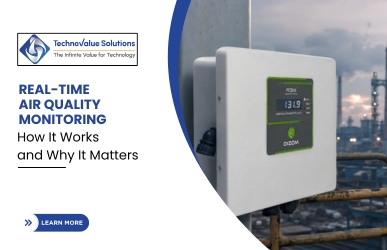
Real-Time Air Quality Monitoring | How It Works and Why It Matters
The Air We Can't See Is the Risk We Ignore
During the COVID-19 pandemic, India lost 530,000 reported lives, and the crisis changed the way we think about public health. Yet, another public health crisis continues to claim far more lives every year, almost silently. Every year, poor air quality quietly contributes to approximately 2.1 million deaths in India in 2021 alone. That is four times the country's official cumulative COVID-19 death toll.
Unlike the pandemic, the challenge is that air pollution is largely invisible. We cannot always see harmful particulate matter, volatile gases, or microscopic contaminants, yet they affect our lungs, heart, and overall well-being every time we breathe. This is why AQI today and understanding what is in the air around us and being able to detect harmful changes as they happen are no longer optional. It is essential.
Real-time air quality monitoring is changing how industries like aviation, mining or even residencies protect humans and the environment. By continuously measuring air quality and providing instant alerts, these systems enable faster decisions, better compliance, and healthier spaces. In this article, we'll explore how real-time air quality monitoring works, why it matters more than ever, and how it is helping create safer environments for everyone.
What Is Real-Time Air Quality Monitoring?
Real-time air quality monitoring is the continuous measurement of the air we breathe, providing live information about the presence of pollutants, airborne particles, and environmental conditions. Unlike traditional methods that rely on periodic sampling or manual inspections, real-time monitoring systems work nonstop and instantly detect changes in air quality. This keeps the operators updated with the potential before they go out of hand.
Applications Across Industries
In mining industry, on-site, where the extraction process is ongoing, crushing and blasting (releases SOx & NOx, critical gases, etc.) and drilling and transportation release particulate matter into the atmosphere. Therefore, it helps to regulate air quality in such sensitive areas.
- Construction and demolition where there is a huge amount of particulate matter released continuously in the air, affecting neighbouring residential areas. Curbing this is essential as it contributes to 23% of global pollution.
- Smart cities and campuses invest in air quality monitoring systems at strategic locations to take actionable insights for pollution and the wellness of the citizens.
- Industrial monitoring helps industries to comply with regulations of maintaining air quality and tracking particulate matter levels with the help of real-time data monitoring equipment.
- Agricultural industry is heavily dependent on rainfall and temperature for good crops. It helps by monitoring weather conditions.
- Sea ports are run by the incoming and outgoing ships, which travel around the globe to transport goods. Hence, data from weathercom and Polludrone devices help with real-time alerts and make informed decisions beforehand.
- Vehicular emissions account for 20-30% of urban pollution, and 95% of all carbon monoxide emissions originate from motor vehicle exhaust. This data makes it important to create action plans to curb air pollution.
Real-time air quality monitoring is essential wherever air quality directly affects safety, product quality or operational continuity.
How Real-Time Air Quality Monitoring Actually Works
Real-time air quality monitoring systems use a network of sensors to continuously measure pollutants and environmental parameters in the surrounding ambient air. Depending on the application, these sensors can detect particulate matter (PM1, PM2.5, and PM10), carbon dioxide (CO₂), volatile organic compounds (VOCs), temperature, humidity, and other odour gases.
The collected data is instantly transmitted to a central monitoring platform (Envizom), where it is analyzed and displayed through dashboards or alerts. If pollutant levels exceed threshold limits, the system immediately notifies operators like EHS, allowing them to take corrective action. This continuous flow of data helps organizations respond faster, maintain safer environments, and make informed decisions based on real-time conditions rather than assumptions.
Why Periodic Testing Is No Longer Enough
Traditional air quality testing gives only periodic data. While it can confirm whether air quality met acceptable limits during the test, it cannot capture unexpected changes that occur between sampling intervals. Factors such as equipment operation, production activities, ventilation performance, occupancy levels, or outdoor pollution can cause air quality to fluctuate throughout the day.
Real-time monitoring bridges this gap by continuously tracking these changes and providing instant alerts when predefined thresholds are exceeded. Instead of identifying problems after they have already affected people or processes, organizations can respond immediately, reducing risks, maintaining compliance, and ensuring consistently safe environments.
Where Real-Time Air Monitoring Makes the Biggest Difference
The biggest advantage of real-time air quality monitoring is its ability to detect changes the moment they occur. Unlike periodic testing, continuous monitoring doesn't wait for the next scheduled inspection; it identifies problems as they happen, allowing immediate action before they escalate.
- Protects air-sensitive industries: The aviation industry is extremely air-sensitive, as operational efficiency of landing and takeoff cycles is dependent on the high local pollution. Onboard passenger safety is also another aspect of the industry to track air quality inside the flight deck, where real-time air quality monitoring is essential.
- Improves worker safety: In chemical processing plants or battery manufacturing facilities, a sudden increase in hazardous gases can put employees at risk. Real-time monitoring enables rapid evacuation or ventilation adjustments.
- Significant contribution to reduce air pollution: As mentioned earlier, construction and demolition contribute to 23% (which can go up to 30% in urban cities) of global air pollution and roughly 30% of urban particulate matter PM10.
Key Air Quality Parameters That Need Continuous Monitoring
To maintain healthy and controlled environments, several air quality parameters should be monitored continuously and maintain the air quality index:
- PM2.5 and PM10: Fine airborne particles that can penetrate deep into the respiratory system and pose serious health risks. They are key indicators of overall air pollution.
- Carbon Dioxide (CO₂): Elevated CO₂ levels often indicate poor ventilation, leading to reduced indoor air quality, discomfort, and decreased productivity.
- Volatile Organic Compounds (VOCs): Chemical vapours released from solvents, paints, fuels, and industrial processes. High VOC concentrations can affect both human health and product quality.
- Temperature: Stable temperature is essential in cleanrooms, laboratories, and manufacturing environments, where fluctuations can impact sensitive processes and equipment.
- Relative Humidity: Excess or insufficient humidity can influence microbial growth, static electricity, product stability, and the efficiency of air filtration systems.
- Speciality Gases (Application-Specific): Depending on the facility, gases such as ammonia (NH₃), hydrogen sulphide (H₂S), sulphur dioxide (SO₂), nitrogen dioxide (NO₂), ozone (O₃), or carbon monoxide (CO) may also require continuous monitoring to ensure safety and regulatory compliance.
Choosing the Right Air Quality Monitoring Solution
Selecting the right air quality monitoring system starts with understanding your environment and the risks you need to manage. Features such as:
- Gas & Particulate Detection: Tracks pollutants like NO₂, O₃, CO, SO₂, VOCs, and particulate matter through either optical, electrochemical, or solid-state sensor technologies.
- Meteorological & Environmental Integration: Monitors weather conditions such as wind speed, wind direction, temperature, humidity, and barometric pressure to give complete context.
- Connectivity & IoT: real-time data through cloud connectivity, supports IoT integration, and sends instant alerts when pollution levels exceed set limits.
- Data Logging & Storage Automatically records and stores air quality data for easy access, analysis, and export in multiple formats.
- Durability: Built with rugged, weather-resistant enclosures to ensure accurate performance even in harsh environmental conditions.
- Remote Management: Enables remote monitoring, troubleshooting, firmware updates, and sensor calibration without requiring on-site maintenance.
Third-generation air quality monitoring systems today, such as Polludrone is a smart equipment that not only measures pollutants and contributes to instant analysis but also can detect anomalies the moment they occur and take immediate corrective action.
Turning Real-Time Air Quality Data into Faster Decisions
Air quality-related deaths remain the world’s most fatal yet overlooked health threats. Unlike a pandemic, it rarely headlines even though it results in millions of deaths annually in India. Polluted air is usually invisible for us, yet we often ignore it until it harms us in a way.
As industries develop, the compliances and regulations become more stringent, hence, air quality monitoring is not just a practice but a necessity. This is where real-time air quality monitoring comes in, where the data monitored is quantified to make immediate decisions, the people operating and residing around are safe, and operations are updating constantly to the changes, which ensures a cleaner future.